Dishwasher troubleshooting
A dishwasher troubleshooting guide is mostly a map of water that cannot leave the tub, water that never arrives, or heat that never shows up.
A dishwasher with the door open and the racks lifted out. The filter is the part under the lower rack on most current tubs.
- Upper rack. The top basket.
- Lower rack. The bottom basket.
- Door. The front door.
- Spray arm. The bar under a rack that throws the water.
- Filter. The cup in the tub floor. Rinse it before you assume the pump has failed.
- Tub. The box the racks sit in.
How to fix a dishwasher is usually a question about water that will not leave, water that never arrived, or a load that is wet because the heater or the rinse aid never did its job. This dishwasher troubleshooting guide stays on the checks that are written into owner manuals. It does not invent a code chart for a machine whose display you have not identified. A load that finishes wet, with an empty tub, is dishwasher not drying. A dark display is dishwasher not turning on.
Before a brand section, do the three checks that solve a large share of "it will not drain" visits. Rinse the filter the manual tells you to remove. Look under the sink: if the drain hose connects to a garbage disposal, a new disposal will not pass water until its knockout plug is removed. If a chrome air gap on the sink is spitting water, that air gap or the hose beyond it is restricted. Not every home has an air gap. The shared symptom is covered in dishwasher not draining.
Whirlpool dishwasher troubleshooting guide
Whirlpool dishwasher troubleshooting on many recent models starts with an F8 E1 code when the drain takes too long. Clean the filter, confirm the hose and the disposal inlet, then read the Whirlpool draining guide. The same corporation builds a lot of KitchenAid dishwashers, so a KitchenAid dishwasher troubleshooting guide often meets the same filter and the same style of F-code. Confirm the code in the tech sheet for that model. Do not assume a 20-year-old KitchenAid uses the current display.
GE dishwasher troubleshooting guide
GE dishwasher troubleshooting is less about a single letter code and more about the model number on the tub. GE Profile, GE Adora, and GE Cafe are GE lines, and their service steps live on GE's site for that model. GE Profile dishwasher troubleshooting and GE Adora dishwasher troubleshooting should start with the filter and the drain connection, then the blink pattern printed for that control, not a pattern copied from a forum. GE Cafe dishwasher troubleshooting is the same idea: identify the model, then use the GE draining guide if the tub is full. A GE dishwasher troubleshooting guide that skips the model tag will send you to the wrong board.
Bosch dishwasher troubleshooting guide
Bosch dishwasher troubleshooting on many U.S. models uses E24 for a drain fault, E22 when the filter is blocked, E25 when the drain path or pump is restricted, and E15 when water is in the base. Many U.S. Bosch dishwashers have no salt compartment. Add salt only if the manual shows a reservoir. The drain-specific steps are in Bosch dishwasher not draining. Bosch maintenance, including the filter and the door gasket, is on the maintenance checklist.
Other brands, still the same water path
Samsung dishwasher troubleshooting belongs with the Samsung draining guide when the complaint is standing water. LG dishwasher troubleshooting, Maytag dishwasher troubleshooting, and Frigidaire dishwasher troubleshooting all begin with the filter and the sink connection. Many current Maytag dishwashers are built on Whirlpool platforms and can show F8 E1. Older Maytag machines do not. Frigidaire Gallery dishwasher troubleshooting is a Frigidaire line: use the Gallery model number, not a generic Frigidaire photo.
Kenmore dishwasher troubleshooting depends on who built that Kenmore. The brand was produced by several manufacturers. Kenmore Elite dishwasher troubleshooting starts by reading the model tag and following the maker named there. Amana dishwasher troubleshooting follows Amana's own support for that model, again after the filter and drain hose.
Electrolux dishwasher troubleshooting, Miele dishwasher troubleshooting, Asko dishwasher troubleshooting, and Fisher & Paykel dishwasher troubleshooting are worth doing from the manual that came with the unit. These machines are less alike than the Whirlpool-family tubs. Miele and Asko in particular expect their own filter and spray-arm steps. Do not swap a Bosch filter procedure onto an Asko and call it done.
Hobart dishwasher troubleshooting is often a commercial machine in a church kitchen or a small restaurant. Hobart's service manual for that model is the source. A household filter article will not match a Hobart undercounter.
Codes for the brands that publish a stable set are collected in the error code library.
Guides in this section
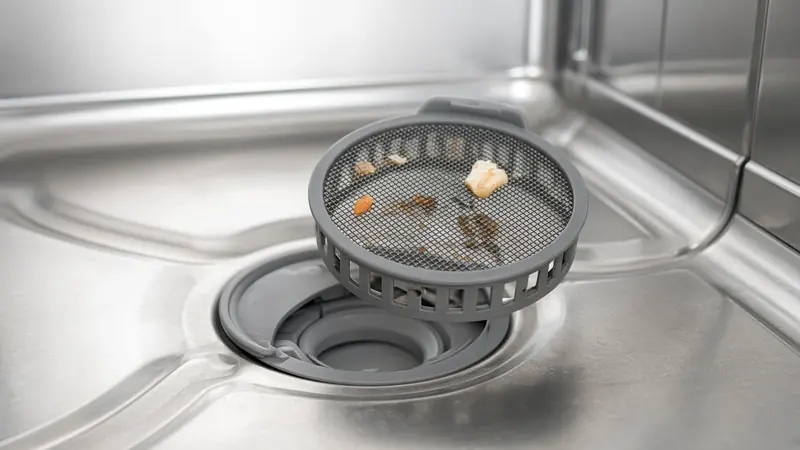
How to clean a dishwasher
How to clean a dishwasher is a filter rinse, a gasket wipe, and one hot cycle with the cleaner your manual names, or with white vinegar in a cup on the top r…
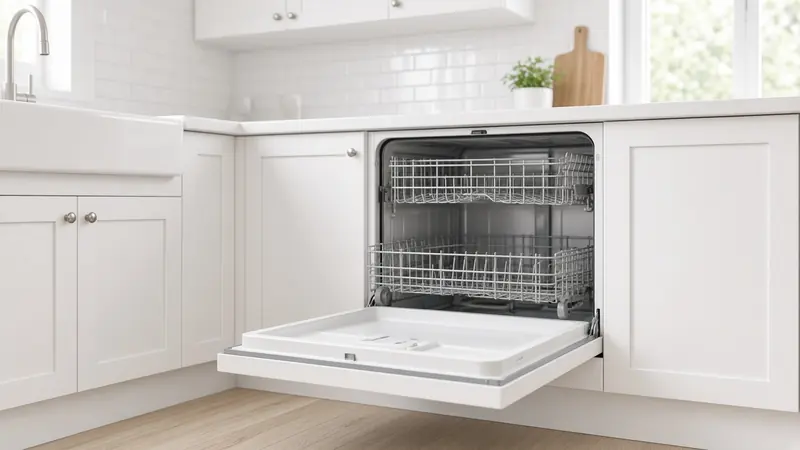
Dishwasher not draining: filters, air gaps, and hoses
A dishwasher not draining usually has a blocked filter, a restricted air gap, a kinked hose, or a knockout plug left in a new garbage disposal.
Whirlpool dishwasher not draining: F8 E1, filter, and hose
A Whirlpool dishwasher not draining on many current models shows F8 E1, Whirlpool's slow-drain code.
GE dishwasher not draining: Nautilus, Cafe, and the filter
A GE dishwasher not draining is not diagnosed from a single blink chart.
Bosch dishwasher not draining: E22, E24, E25, and the filter
A Bosch dishwasher not draining on many models shows E22 for a blocked filter, E24 for a drain fault, or E25 for the pump or a hose restriction.
Samsung dishwasher not draining: use the model page, then the filter you can see
A Samsung dishwasher not draining needs the model number from the door frame before any parts talk.
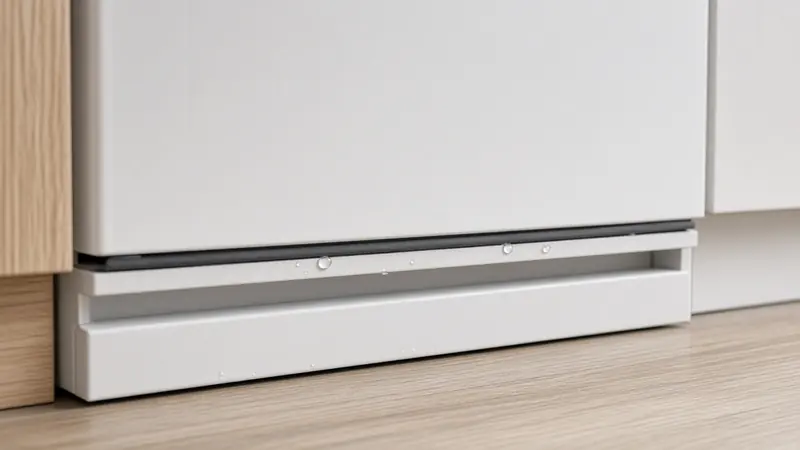
Dishwasher leaking from bottom: door gasket, suds, or water under the tub
A dishwasher leaking from bottom is usually suds, a packed filter that lets the tub overfill, or a door gasket that is folded, dirty, or not seating.
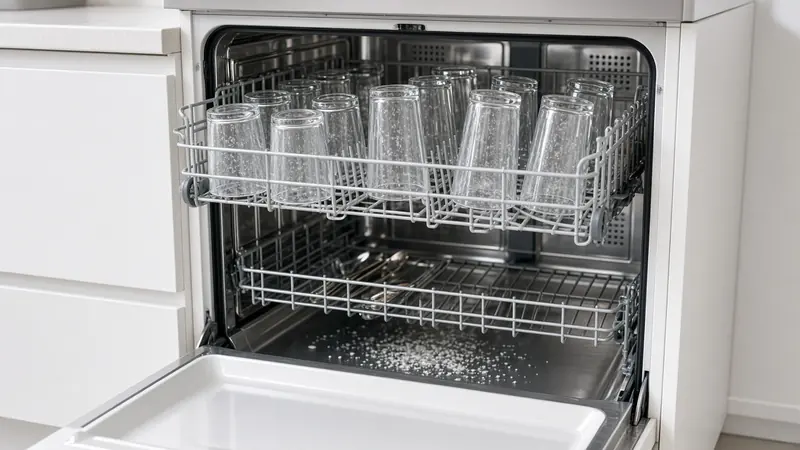
Dishwasher not drying
A dishwasher not drying, when the tub itself is empty, is usually rinse aid, a load of plastic, or a heated-dry option the manual has to confirm for that model.
Dishwasher not cleaning: spray, heat, film, and loading
A dishwasher not cleaning can still finish on time and leave soil on the plates.
Dishwasher not turning on
A dishwasher not turning on means the display is dark or a start press does nothing.