On this page
If the tub is still full, rinse the filter the diagram for this model shows before you treat the pump as failed. A Samsung dishwasher not draining should start on Samsung's own model page, not on a generic drain list. Open the door and read the model number on the frame. Enter it at Samsung support and open the diagram that shows the filter and the drain hose for that unit. This brand's tub layout is not the same as a Bosch filter or a GE sump, so the picture has to match your badge.
Samsung dishwasher not draining water still means a tub that stays full. The filter, the hose, and the disposal knockout are the checks. A code on the display is whatever that model's manual says it is.
Shared drain facts still apply, and they are written once in the dishwasher not draining guide: a filter the manual says to rinse, a hose that can kink, a sink that drains slowly, and a new disposal whose knockout plug is still in place. Use that page for the house-side path. The steps below stay with what you can see on a Samsung tub and when to stop. A Bosch dishwasher not draining and a GE dishwasher not draining use their own codes and their own filter shapes. Do not import those codes onto a Samsung display.
Water that never left, or water that came back
Look in the tub an hour after the cycle, not during a mid-cycle pause. Some Samsung cycles sit quiet while they heat or sense the load. The manual for that model number says which pause is normal. Water covering the floor after the display says the cycle ended is a failed drain. Water that left and then returned, especially if the sink was full, is a backup from the sink or the air gap, not a pump that failed to start.
Many dishwashers made in recent years have a filter the manual says to rinse. On many Samsung models that filter is a stack in the tub floor, reached after the lower rack is lifted out. Twist or lift only in the direction the manual draws. If no filter is visible, do not pry at the tub. A hidden screen is not an invitation to lever at the sump with a screwdriver.
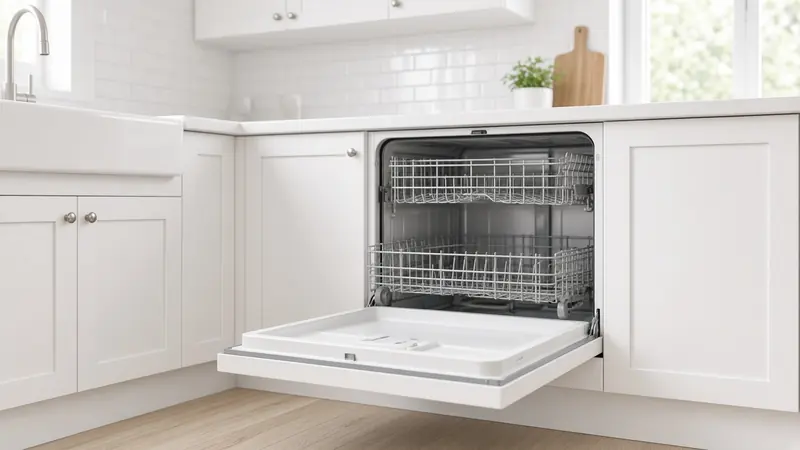
The sink side of a Samsung drain hose
Pull the hose only if you can see it under the sink without disconnecting fittings you cannot reseal. A kink behind the cabinet, or a hose that was looped flat on the floor, will stall the pump. Samsung's install guide for that model shows whether the hose needs a high loop under the counter. Follow that drawing. Do not invent a new route that leaves a low pocket full of food.
A dishwasher connected to a new disposal will not drain until the disposal's inlet knockout plug is removed. If you do not do plumbing, stop. The plug is inside the disposal inlet, and guessing with a drill floods the cabinet. Many U.S. sinks have a chrome air gap. Water spitting from it means the air gap or the hose beyond it is restricted. Not every home has an air gap. If yours does and it spits, the restriction is downstream of the dishwasher pump.
What you see in the tub
| What you notice | Likely cause | Safe check |
|---|---|---|
| Film of water only in the filter well after a normal cycle | Sump water the manual may call normal | Read that model's manual before you call it a failed drain |
| Tub floor covered after the cycle ends | Filter, hose, sink, or pump | Rinse the filter the diagram shows. Trace the hose for a kink |
| No filter visible in the tub floor | Different Samsung layout, or the cover is still installed | Stop prying. Use the manual's photo before you touch the sump |
| New disposal, dishwasher never drained | Knockout plug still in the inlet | If you do not do plumbing, stop and hire a plumber |
| Air gap on the sink spits during drain | Air gap or the hose beyond it is restricted | Clean only what the install guide shows. Not every sink has an air gap |
| Pump is silent, filter and hose are clear, tub stays full | Drain pump or control | Stop. Do not bypass the door latch or the float |
Samsung checks in a safe order
Read the model and bail the tub
Copy the model number from the door frame. Scoop standing water into a bucket so the next test does not overflow the door. Leave the breaker on only when you are ready to listen for the pump. A soaked floor is a reason to stop and dry the area first.
Open the Samsung diagram
On Samsung's support site, open the filter and drain-hose view for that model. Note whether a little water in the sump is described as normal. Note the button the manual uses to cancel and drain. Do not press a sequence copied from a different Samsung.
Rinse the filter you can see
Remove the lower rack. Take out only the filter pieces the diagram names. Rinse them under the tap. Food packed in the mesh is a complete explanation for a slow drain. Seat every piece before you run water again. If the diagram shows no user filter, skip this step.
Check the hose, the sink, and the air gap
Unkink the hose if you can do that without opening fittings. Run the sink. If the sink is slow, clear the sink before you blame the dishwasher. If an air gap spits, treat the restriction downstream. If there is no air gap, do not install one as an experiment.
Stop at a new disposal
If the drain hose ends at a disposal that was just installed, the knockout plug is the first suspect. That is plumbing. Stop if you do not do that work. The filter rinse will not fix a closed inlet.
Listen once, then quit
Start the drain or cancel the manual names. A hum with the water leaving is progress. Silence, or a hum with a full tub after the filter and hose are clear, ends the home checks. Do not open the door latch, bypass the float, or drop the tub.
After one successful drain
Run an empty rinse. The tub should be down to the small sump film the manual allows, and the air gap should stay quiet. If the empty rinse drains and a dirty load does not, the filter loaded up again. If the empty rinse fails, the pump or the house line is still blocked, and the stop note applies. Dishwasher care for other brands stays in the dishwasher section, and filter rinsing reminders are listed with maintenance and cleaning.
Questions readers ask
Is a little water in the Samsung filter well normal?
Often yes. Many dishwashers keep a small pool in the sump so the seals stay wet. The manual for that Samsung model says whether a shallow film in the filter well is expected. Standing water that covers the tub floor, rises into the lower rack, or is still there an hour after the cycle is a drain failure. Bail that water out before you run the cycle again.
Which Samsung code should I look up?
This guide does not name a Samsung dishwasher code, because a code that is common on one series is wrong on another. Read the characters on your display and match them in the manual for that model number, or on Samsung's support page for that model. Do not borrow a Whirlpool, Bosch, or GE code and assume the letters mean the same thing.
What if the dishwasher was just tied into a new disposal?
A dishwasher connected to a new disposal will not drain until the disposal's inlet knockout plug is removed. The plug is a metal disc inside the disposal's dishwasher inlet, and it is a plumbing job. If you do not do plumbing, stop and hire someone who does. Running another cycle only fills the tub again. The filter is not the cause if the hose ends at a plug that was never knocked out.
The sink gurgles and the air gap spits. Where is the clog?
Many U.S. sinks have a chrome air gap on the deck. Water spitting from it means the air gap or the hose beyond it is restricted. Not every home has an air gap. If the sink itself drains slowly, the dishwasher is sharing that clog. Clear the sink first. If the air gap is packed with grease, a technician or a plumber should clean the path the install guide shows rather than you forcing a wire into the hose.
Should I start another cycle to force a drain?
No, not while water is standing in the tub. Use the cancel or drain control the manual names for that model, or bail the tub with a cup. A second full cycle on a blocked drain can leak at the door. If the pump never hums and the filter and hose are clear, stop. The drain pump has to be tested in service, not forced from the keypad.