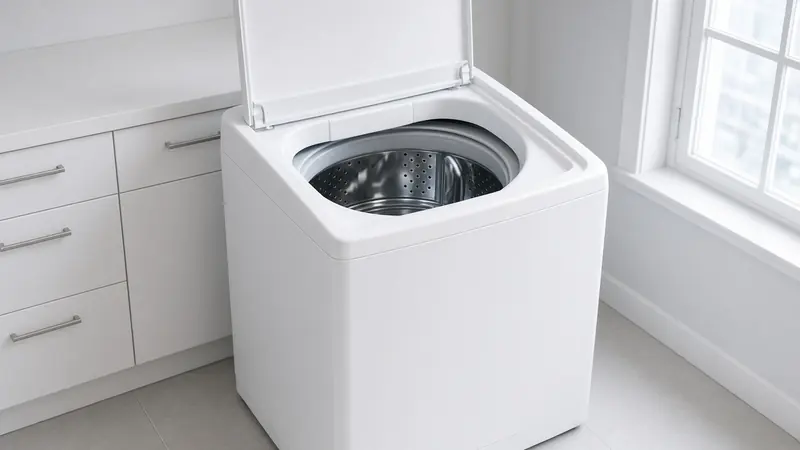
A front-load washer, from the top down. The blue numbers match the list. Brands move these parts.
- Top panel. The cover across the top.
- Detergent drawer. The small tray at the front of that panel.
- Door. The round window on the front.
- Gasket. The rubber ring you see when the door is open.
- Drum. The basket the clothes sit in.
- Cabinet. The outer box. This drawing does not open it.
- Drain hose. The hose at the back that empties the tub.
- Leveling foot. One of the feet under the cabinet. A washer that walks is often this, or the load.
On this page
Washing shoes in washing machine is a real load, with a real limit. GE's shoe-washing page says you can wash shoes if the material is machine-washable, and not if they are leather, suede, or a fabric marked non-machine-washable. The tongue or the box of that pair decides. A canvas sneaker with a wash mark is not a leather boot. How to wash sneakers in washing machine is the same GE sequence when the sneaker is marked washable, and it is a no when it is not.
The vinegar dose in how to clean a washing machine is for an empty machine. Do not pour that tub-clean amount onto shoes and call it the same job. GE does say you can add vinegar to the shoe wash to help with odor. That is a small addition to the shoe load, not two cups in an empty drum.
Which shoes stay out
| Pair | GE's line | What you do |
|---|---|---|
| Marked machine-washable | Allowed | Follow the steps below |
| Leather or suede | Do not machine-wash | Leave them out. This page does not add a leather method |
| Marked do not wash | Do not machine-wash | Follow the shoe label, even if the pair looks like canvas |
| No care mark at all | GE requires machine-washable material | Do not guess. Hand-clean or ask the shoe maker |
GE's steps, in order
Knock off the dry mud
Remove chunks of dirt before the shoes go in. A washer is not a mud scraper. Clumps become grit in the next load of clothes.
Laces and insoles out
GE says remove the laces and the insoles. Wash the insoles by hand. Laces can go in the bag with the shoes.
Bag them
Put the shoes and laces in a mesh bag or a pillowcase and close it. Loose laces wrap around other clothes and can catch in the door area of a front-loader.
Balance with towels
GE says wash with old towels, enough of them to weigh about as much as the shoes. Two shoes alone are a lump on one side of the drum. An unbalanced spin is the banging covered in washing machine shaking violently. Stop the cycle if the cabinet walks. Do not add a brick.
Cold water and liquid detergent
GE specifies cold water to protect the shoes, and liquid detergent because powder can stick inside them. Use the amount you would for a small load, not a guess measured in a coffee mug.
Optional vinegar for odor
GE says you can add vinegar to the wash to help remove odor. Do not mix that vinegar with bleach. Do not use the empty-machine tub-clean recipe.
Drying is not part of GE's wash
GE's page stops at the wash. It does not say to tumble the shoes on hot. Air-dry them, stuffed with paper so they hold a shape, away from a heater vent. A hot dryer is a separate question, and this article does not turn it into a recommended step. Heat can separate glue that the cold wash did not touch.
Questions readers ask
Can I wash leather sneakers if I use cold water?
No. GE excludes leather and suede, and any shoe marked non-machine-washable. Cold water does not lift that exclusion.
The insoles smell. Do they go in the bag?
GE says insoles should be hand washed. Keep them out of the machine.
Will two shoes throw the washer off balance?
They can. GE's balance is old towels about equal to the weight of the shoes. If the cabinet walks, stop the cycle.
Should I use the tub-clean cycle for shoes?
No. Tub clean is an empty hot cycle for the machine. Shoes are a cold, bagged load with a normal small-load amount of liquid detergent.