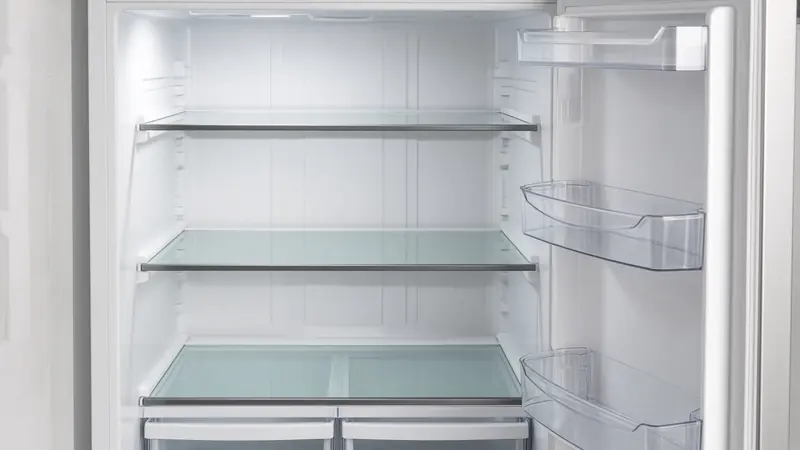
A refrigerator with the door set aside. Refrigerant stays in the sealed system and is not drawn here.
- Door. The door, pulled forward.
- Gasket. The seal on the door. A gap here warms the food.
- Shelf. A shelf in the fresh-food section.
- Crisper. A drawer at the bottom for produce.
- Cabinet. The outer box.
- Condenser coils. The coil cover, usually along the bottom front or the back. Dust there is a cleaning job, not a refrigerant job.
On this page
What is freezer burn is dried food, not a spoiled-food smell test. USDA's freezing page says food held constantly at 0°F stays safe, and only the quality drops over time. Freezer burn is the quality problem: grayish-brown leathery spots where air reached the surface. The food under an intact frozen package is not unsafe because those spots exist. Trim them. If the whole piece is dry and tasteless, USDA says you may have to discard it for quality, not because the spots created a pathogen.
A package that thawed and sat warm is a different problem. Freezer burn does not tell you the freezer failed. Soft packages, ice cream that melted and refroze, or a thermometer above 0°F belong on what temperature a refrigerator should be. Frost on the cabinet wall is also different. That is how to defrost a freezer.
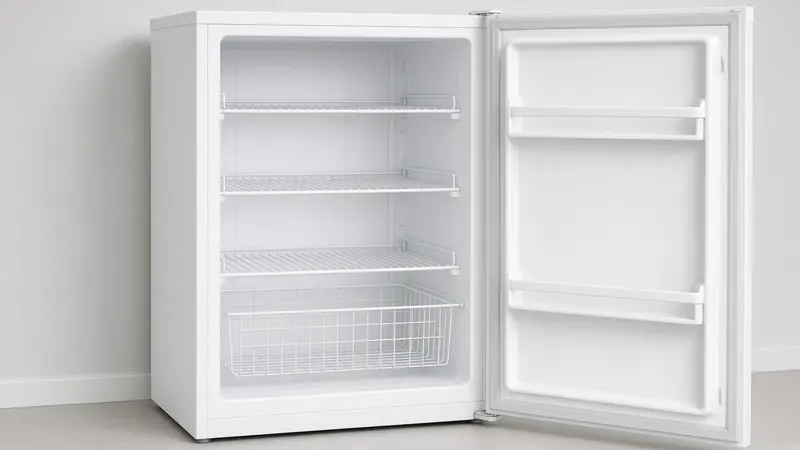
What does freezer burn look like?
What does freezer burn look like, in USDA's description, is grayish-brown leathery spots on the surface. On poultry, the same agency describes grayish brown leathery spots from air reaching the meat. USDA's Kitchen Companion also describes white, dried-out patches that make meat tough and tasteless. Ice crystals on the food or inside a loose bag are the clue that air and moisture moved. Color alone, without the dry texture, can be freezer lighting. Press the spot. Leathery and pale is the burn.
| What you see | What it means | What to do |
|---|---|---|
| Gray-brown dry spots, food still hard-frozen | Air reached the surface. Quality only, per USDA | Cut the spots off before or after cooking |
| The whole piece is chalky and tasteless | Too much drying to be worth cooking | Discard for quality |
| Package is soft, or the freezer is above 0°F | This may be a thaw, not just burn | Use the temperature guide. Do not trim and assume it is safe |
| Ice on the cabinet, food packaging is tight | Frost in the box, not burn on the food | Defrost the cabinet when the frost layer is about 1/4 inch |
Packaging that keeps air out
USDA's packaging page says you may freeze meat or poultry in the store wrap, and that the wrap lets air through. Unless you will use it in a month or two, overwrap with airtight heavy-duty foil or freezer wrap. The poultry page uses the same idea with a two-month line: if poultry will stay frozen longer than two months, wrap the porous store package in airtight heavy-duty foil, freezer plastic wrap, freezer bags, or freezer paper. Leave vacuum-sealed packages as they are. USDA says not to rinse meat or poultry before freezing.
If a package tears in the freezer and the food is still frozen, USDA says the food is still safe. Overwrap it. The tear is how the next round of burn starts, not a reason to throw out a rock-hard roast.
Cool it first
Do not put a steaming pot into the freezer. Chill cooked food in the refrigerator, in shallow containers, then freeze it. A hot container warms the packages around it.
Press the air out
Use a freezer bag or freezer paper, press out the air, and seal. A loose sack of air is the burn waiting to happen. Freezer paper is the plastic-coated paper USDA describes for this job, not wax paper from the drawer.
Date it and face the old food forward
Kitchen Companion's practical order is to date the package and put newer food behind older food so the old package gets used.
Hold 0°F
Put an appliance thermometer in the freezer. USDA's freezing page says a compartment that cannot hold 0°F is for short storage, and a freestanding freezer at 0°F or below is the long storage. The refrigerator compartment is a separate 40°F question.
After the spots are there
Cut the burned portion away before or after cooking, which is USDA's instruction for both meat and poultry. Cook the rest as you would any frozen food of that type. Do not thaw it on the counter. Heavily burned food that is dry all the way through can be discarded because it will not taste like the food you froze.
A freezer that will not hold temperature is not fixed by tighter bags. Use freezer not freezing when the thermometer will not reach 0°F. Other cold-storage guides are under refrigerators and freezers.
Questions readers ask
Is freezer-burned chicken safe?
If it stayed at 0°F, USDA says the dry spots do not make it unsafe. Cut them off. Throw it out for quality if it is dry and tasteless through the piece. If the package thawed and sat warm, the spots are not the safety test.
Can I freeze meat in the store tray?
Yes for safety, and the store wrap lets air in. USDA says to overwrap it if you will keep it longer than about a month or two, and longer than two months for poultry in porous store plastic.
Does a colder setting than 0°F stop burn better?
USDA's safety line is a constant 0°F. Burn is air on the food. A colder box does not fix a loose bag, and this page does not invent a lower setpoint.
The freezer is full of frost. Is that freezer burn?
Frost on the walls is cabinet frost. Freezer burn is on the food. Defrost the box when the frost is about a quarter inch, and rewrap any package that is torn.