On this page
A Bosch dishwasher not draining is read from Bosch's own codes, not from a Whirlpool F8 E1 article. On many Bosch dishwashers, E22 is a blocked filter, E24 is a drain fault, and E25 points to the drain pump or a hose restriction. E15 means water in the base. Confirm every one of those in the manual for your model. The code list and the manuals start at Bosch Home. Shared sink checks are one paragraph on the general drain page.
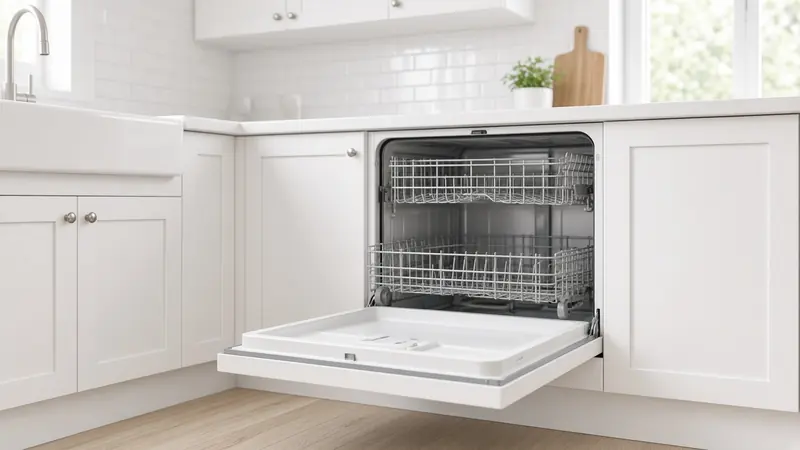
Why is my Bosch dishwasher not draining
Why is my Bosch dishwasher not draining with E22 on the display or on the floor is the filter until you have rinsed it. My Bosch dishwasher is not draining with E24 or E25 is the hose, the air gap, the disposal knockout, or the pump. Those are not the same visit. E15 is not a drain code you clear with a rinse. Water in the base means something leaked. Stop, cut power, and do not keep running cycles.
Some Bosch models show the code on a display. Some project it on the floor in front of the door. The manual says which your series uses. A 300, 500, or 800 series console is not a reason to invent one button sequence for all of them. Use the book that matches the model tag.
Bosch dishwasher troubleshooting not draining
Bosch dishwasher troubleshooting not draining starts with the filter the manual tells you to remove. Most machines made in recent years have one. Turn or lift it only as that drawing shows, rinse it, and seat it until it locks. A loose filter can leak, run noisy, or bring the code back. If no filter is visible, do not pry at the tub. Glass, seeds, and paper labels are the usual E22. A clean filter that still shows E22 means you stop guessing and re-read the code definition for this model.
Many U.S. Bosch dishwashers have no salt compartment. Mention salt only when the manual shows a reservoir. A drain failure is not a missing-salt failure. If the manual has no salt cap, do not go looking under the tub for one. Adding salt to a model that has no reservoir does nothing for E24 or E25.
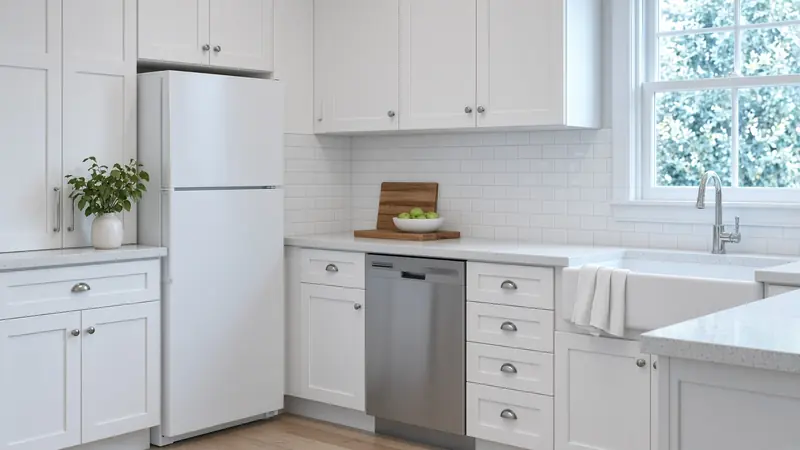
E24, E25, and the sink end of the hose
After a clean, seated filter, E24 and E25 move you under the sink. Many U.S. sinks have a chrome air gap. Water spitting from it means the air gap or the hose beyond it is restricted. Not every home has an air gap. A new disposal will not accept dishwasher water until the knockout plug is removed. If you do not do plumbing, stop. A kink you can see without pulling the dishwasher is fair to straighten. The hose clamped behind the chassis is not a tug-of-war from the cabinet.
The general version of those sink checks, written for every brand, is dishwasher not draining. Whirlpool's F8 E1 is a different code on a different badge: Whirlpool dishwasher not draining. GE's lights are model-specific and are not E24: GE dishwasher not draining. Browse the rest under dishwashers.
| What you notice | Likely cause | Safe check |
|---|---|---|
| E22 | Blocked filter on many Bosch models | Rinse and reseat the filter exactly as this manual shows |
| E24 | Drain fault | Air gap, knockout, and a kink you can see. Confirm the code in the manual |
| E25 | Drain pump or hose restriction | Clean the filter first. If the code remains, stop before replacing the pump |
| E15 | Water in the base, a leak | Power off. Do not keep washing. Technician finds the leak |
| Quiet pump, you think it never drained | Some Bosch units are very quiet | Watch the water, not only the sound. A full tub is not normal residual water |
| Advice to add salt | Many U.S. models have no salt reservoir | Add salt only if this manual shows a reservoir. Salt does not fix a drain code |
Checks in order
Write the code and confirm it
E22, E24, E25, and E15 are the drain and leak codes used on many Bosch dishwashers. Your manual has to list the one you see. A code that is not in that book goes back to Bosch's site for the model tag. Do not borrow a meaning.
If the code is E15, stop
Water in the base is a leak. Cut power. Do not rinse the filter as a cure and do not run a reset loop all afternoon. A technician has to find where the water entered the pan.
Rinse the filter for E22
Remove it the way the manual shows. Rinse debris out. Seat it until it locks. A filter left loose will not clear the code. No filter in the drawing means you do not dig for one.
Check the sink for E24 and E25
Air gap, disposal knockout, and a visible kink are the owner steps. Plumbing you do not do is a stop. A buzzing pump and a full tub, after those are clear, is the pump or the hidden hose.
Ignore salt unless the manual shows it
Open the manual to the salt page. If there is no reservoir, close the book. U.S. models often have none. Salt will not drain the tub.
Judge the water, not the noise
Some Bosch dishwashers are quiet enough that a finished cycle sounds like it skipped the drain. Look in the tub. A small amount in the sump can be normal if the manual says so. A tub of standing water is not. If that water remains after the steps above, hire a technician.
Questions readers ask
What is the difference between E22, E24, and E25?
On many Bosch dishwashers, E22 is a blocked filter, E24 is a drain fault, and E25 points to the drain pump or a hose restriction. Confirm those definitions in the manual for your model before you buy a pump. E22 is the code that a rinsed, reseated filter can clear. E24 and E25 survive a clean filter when the hose, air gap, knockout, or pump is still blocked. E15 is not in that drain trio. E15 means water in the base, and you stop.
Should I add salt if my Bosch will not drain?
Only if the manual for your model shows a salt reservoir. Many U.S. Bosch dishwashers have no salt compartment. Salt treats hard-water spots on machines that were built with a reservoir. It does not push water out of the tub and it does not clear E22, E24, or E25. If you cannot find a salt cap in the manual, do not remove panels looking for one. Rinse the filter the manual shows, and treat E15 as a leak instead of a chemistry problem.
The code is shining on the floor. Is that the same as the display?
On many models, yes. Some Bosch dishwashers project the code onto the floor. Others put it on a display on the door. The manual for your series says which you have and lists E22, E24, E25, and E15. Write the code down before it times out. A 300, 500, and 800 series do not share one control panel, so do not press a sequence from a different series to clear it. Match the model tag first.
I hear almost nothing at the end of the cycle. Did it fail to drain?
Bosch designs many of these machines to be quiet, so silence is a weak clue. Look at the water. A small amount left in the sump can be normal if your manual says so. A pool under the lower rack is not. If that pool is there, read the code if one is showing, rinse the filter, and check the sink end of the hose. Do not pull the dishwasher out just because the drain was hard to hear.
Can I clear E15 by resetting the breaker?
A breaker reset does not remove water from the base or fix the leak that put it there. E15 means that water is present. Cut power and leave the dishwasher off. Do not tip the machine, drill the pan, or tape the float down so the code goes away. Those shortcuts flood the kitchen or leave a live leak. A qualified technician should find the source. Filter rinsing is the E22 step, not the E15 step.